Every fortnight we’ll bring you some technical updates that we feel you’ll find useful.
Today’s topics are SSAI, OMSDK and some handy free programmatic tools worth trying out.
Handy & Free Tools
Please see below for a list of free and handy tools for all AdOps and TechOps teams.
adop.tools: A famous bookmark for AdOps teams – adops.tools is maintained by a Kiwi comrade, Andrew McLeod. Boasts a very handy CPM calculator, character counter, 3PAS Tag Testers & UTM Link Builder.
Fiddler: If you refuse to (or can’t afford to) pay for premium a debugging proxy tool like Charles, then I’ve always found Fiddler to be a very solid free option. Pro premium versions of Fiddler now also exist, but the free version can still get the job done if you’re fully au-fait with technical solution like this.
Publift’s Adwizard: A superb chrome extension developed and maintained by our very own IAB AU member Publift – which allows you to view information from the ad-server and header bidding performance such as size mapping, targeting attributes and Prebid auction details. Additional premium blocking/identification tools are also available for Publift clients.
Ad Manager Tag Generator & Tester: A classic go-to tool for any GAM publisher client, this handy tool allows you to customise and generate ad tags without having to manually edit the code. Just be aware that this is not an official Google offering as it’s hosted and maintained by a third-party.
Google Tag Manager Preview tool: GTM has recently dramatically evolved it’s Preview & Debug mode capabilities. GTM now enables users to better manage any pages upon which your container code is implemented and can preview which tags are firing and what kind of data is being sent out to analytics & marketing platforms. These changes are also linked into the Google Tag Assistant chrome extension.
Headerbid Expert: Prebid’s very own chrome extension tool for detecting and measuring header bidding partner bid responses. Allows you to review latency, asynchronous loading and generally optimise the overall performance of any of your Prebid.js header bidding partners.
Test A Tag: A handy lightweight web-app, Test-A-Tag is designed to preview ad tags directly on various browsers. It can (unofficially) support standard banner ads with full HTML5, MRAID and VAST attributes.
HTML5 Validator: You can easily check the settings of your third-party tag creatives using this validator, as recommended by Google – which can also validate and check whether your ad renders into the right size and if the click tag works as required.
Cookie Status: A useful ongoing resource – CookieStatus collects and displays all of the latest information on the various status of tracking protection mechanisms implemented by all the major browsers and browser engines. Includes visuals and timelines and acts as an excellent quick perusal resource.
PubMatic’s app-ads.txt Dashboard: Kudos to the expert devs over at PM for dutifully tracking the ongoing adoption of the app-ads.txt standard. You can also split it out by both Android and iOS.
IAB Tech Lab’s VAST Tag Validator (Tech Lab members only): Admittedly it’s only free to IAB Tech Lab members… but felt compelled to include it. The VAST Tag Validator helps you validate the structure and content of your VAST tag against VAST specifications. It tests for required nodes and attributes in a specific set of scenarios. You can also find the VAST XSD and sample VAST Tags. Supports VAST versions 2,3 and 4.
SSAI Workshop Update
Recently, Mike Midden over at IAB Tech Lab, hosted a series of workshops examining the broad benefits of SSAI with a lens on existing challenges when it comes to the nature of using server side technology.
See below as a summary of the key take-aways from those sessions…
Targeting: Contextual targeting is important and valuable; however, in a context only approach, personalisation is lost. Persistent device IDs can be excellent for targeting in a contained environment, but each platform has its own – leading to fragmentation and no unified view of a user. User agent + IP address is commonly used to connect a user’s household devices, however there is no way for the user to opt out, and different platforms may handle IP + UA inconsistently. Finally shared IDs allow for persistent, privacy protected user level targeting but require broad adoption to succeed.
Genres: Utilising genres will allow brands to seek consistent environments across video publishers to align with the most relevant content for their creative message and drive better results. As such the industry needs to support a standardised taxonomy and consistent means of communicating this through the bidstream.
Delivery: Ongoing challenges remain around delivering a seamless high-quality viewing experience for CTV, ad creative asset encoding, client-side processing and offline viewing. There was strong advocacy for the adoption of VAST 4 features including the use of a mezzanine file with a high bitrate, Universal AdID, the Digital Video Ad format Guidelines and macros.
Measurement & Verification: Any ad servers, measurement vendors, buyers and others across the ecosystem need access to basic device and environment data – which is critical for measurement, verification and fraud analysis. This data is passed in the bid request to some intermediaries (DSPs/SSPs) today but not to others. The Tech Lab maintains a list of VAST player macros which allow publisher media players to pass data such as user agent, app store IDs and content identifiers in a standardized format into VAST calls.
Fraud: CTV fraud has recently been demonstrated as a significant and growing problem. In these environments bad actors are more easily able to spoof legitimate SSAI vendors and generate invalid traffic (IVT) using device farms, app misrepresentation and mixing valid/invalid traffic sources.
It is recommended that the industry continues to adopt the Tech Lab App Identification Guidelines, sellers.json and SupplyChain Object and adopt the forthcoming CTV version of app-ads.txt (due out in November 2020).
OM SDK for web video – an(other) update
As we look forward to this forthcoming release (as previewed in a recent webinar) I thought it useful to keep sharing some more information and some ‘sneak peek’ visuals on this OM SDK update. Yes, I know I’m really banging the drum on this release – but I think it’s a big foundational step towards were the industry needs to get to on cross-media measurement and will be looked upon as a key iteration in years to come.
The Open Measurement software development kit (OM SDK) will soon enable third-party ad measurement services to collect signals regarding ad impressions and performance on web video inventory. These signals are sent by the Open Measurement Interface Definition (OMID) API.
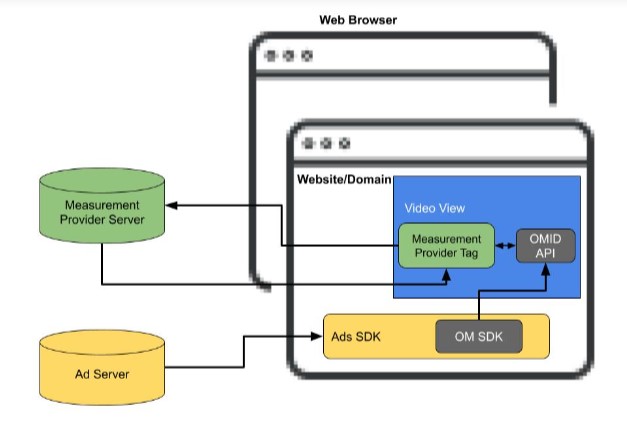
Components
The OM SDK includes both native libraries and JavaScript.
● Measurement Provider’s tag is trafficked with the ad creative.
● Ad SDK initiates the OM SDK which triggers the OM SDK Javascript or OMID API.
● Measurement Provider tag listens to events in OMID API and sends the data to its servers.
 Scope
Scope
OM SDK for web video applies to the broadcast and exhibition of audio-visual content via Internet or mobile technology that supports Web Video applications that load and render all viewable content exclusively through HTML5 including desktops, laptops, tablets and mobile phones, any connected TVs (“CTV”), over the top (“OTT”) devices or gaming consoles (collectively “Web Video Devices”), but excluding any devices where HTML5 video delivery is not supported, or any application that uses device native UI frameworks for content, navigation, or advertising delivery.
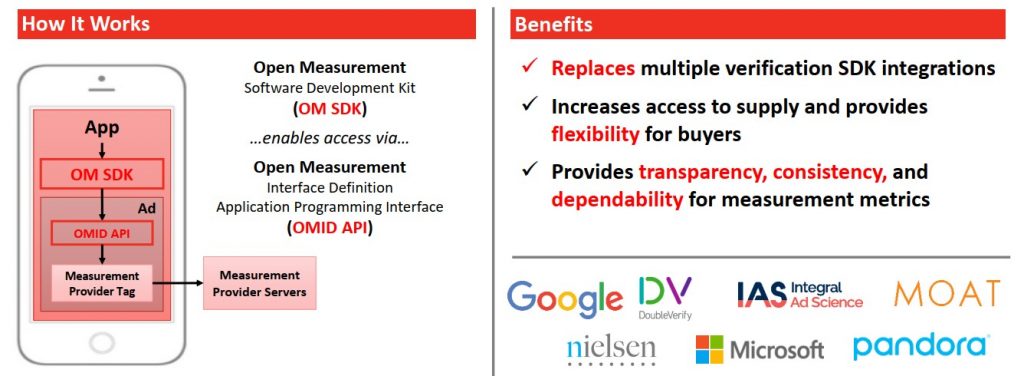
Some CTV and OTT platforms may use HTML5 delivery as described above and may eventually be supported with OM SDK for web video. OM SDK can be delivered and implemented using the IAB Video Ad-Serving Template (VAST), VSuite technology supported in OM SDK for web is described in the following table:
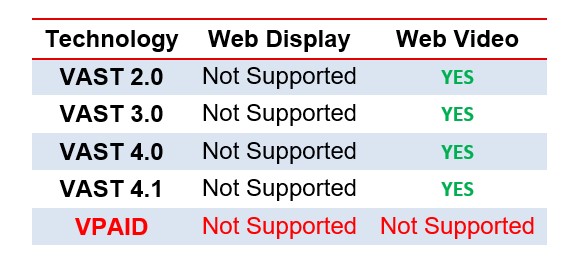 Limitations
While OM SDK facilitates features like brand safety and fraud detection, logic for execution is not yet built-in. The limited support for these initial features is listed below:
- Brand Safety: Performed by Measurement Provider tag. No logic in OM SDK.
- Fraud Detection: Performed by Measurement Provider tag. No logic in OM SDK.
- Advertising ID: No retrieval logic using OM SDK.
Timelines
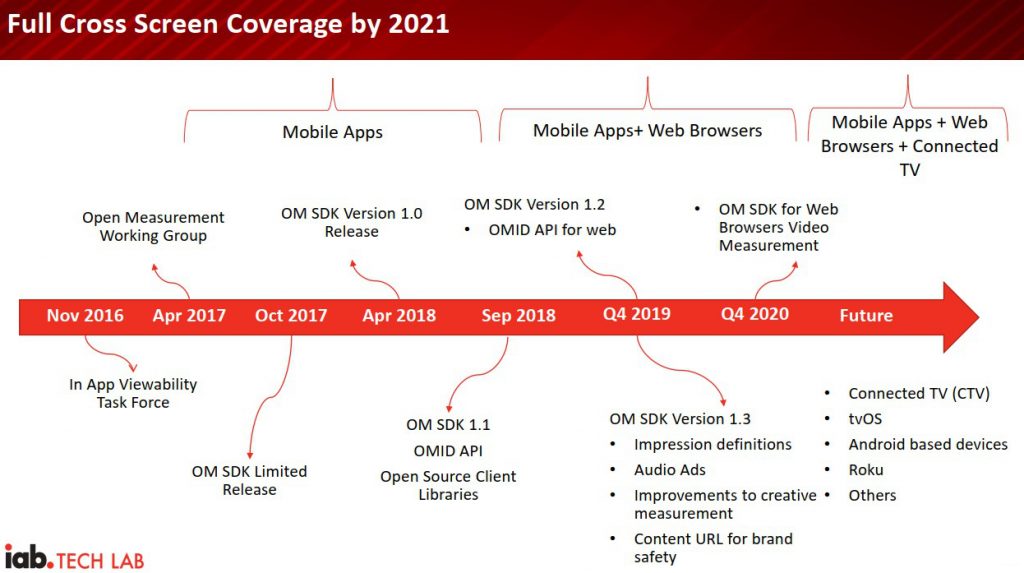
In terms of rollout and timelines see the below for a recently updated roadmap… and as soon as we can share more… we will.