
Every fortnight or so we’ll bring you some technical updates that we feel you’ll find useful.
Today’s topics are Heavy Ads, a snapshot of the IAB Tech’s plans for 2021 and evolution in AI.
Heavy Ads Intervention
In May this year, Google announced that it would start removing ‘heavy ads’ in Chrome from September 2020 onwards (Chrome 85). Ads are considered as being heavy if the user has not interacted with it and it also meets any of the following criteria:
- Used the main thread for more than 60 seconds in total
- Used the main thread for more than 15 seconds within any 30 second window
- Used more than 4 megabytes of network bandwidth
These thresholds were inspired by the (now since sunset) IAB Lean Standards and were refined by looking at Chrome’s metrics at the 99.9th percentile of network and CPU usage in ads. Google found that while only 0.3% of ads exceed this threshold on average, they account for 27% of network data used by ads and 28% of all ad CPU usage. What results is the ad being unloaded from the iframe and a message being displayed, as per the below.
 The intent is to improve the consumer experience and to potentially block these previously observed ad behaviours:
- Ads that mine cryptocurrency
- Ads that load large, poorly compressed images
- Ads that load large video files, before a user gesture
- Ads that perform expensive operations in javascript, such as decoding video files, or CPU timing attacks
It’s worth ensuring that any AdOps teams are aware of these parameters as a part of their testing and QA procedures and to ensure that they implement the necessary monitoring requirements via the Reporting API. For more technical information on this topic you can read this article on the Google Developers site.
IAB Tech Lab’s Aims for 2021
2020 has finished on a real high-note for IAB Tech Lab with the news of the release of OM SDK for web video advertising. This will allow publishers and video players to offer a single, consistent, scalable, and accurate solution to measure impressions and viewability – and removes the reliance upon VPAID.
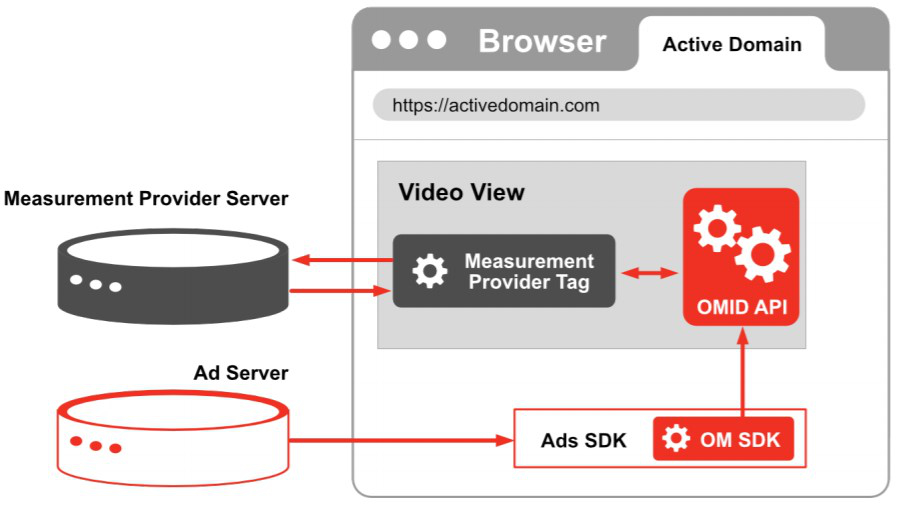
For more info on this please click here
Now, as we look towards 2021 I thought it useful to review the areas of key concern for IAB Tech Lab next year. Please see the table below for a summary:
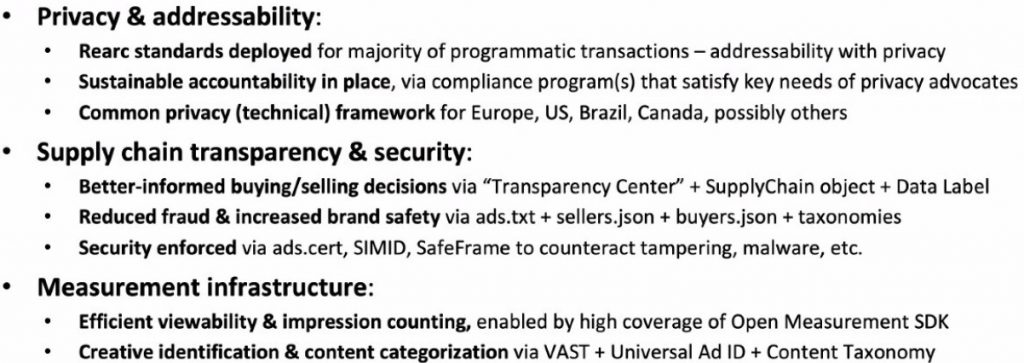
Project Rearc obviously plays a major role in next year’s efforts (for the most recent update on Project Rearc, please visit the webinar page here), work has already started on standards for improved buy-side transparency (i.e. buyers.json) and leveraging the capabilities of Open Measurement for more devices and products will be an important evolution. Lots to look forward to…
DeepMind evolves from Ads, to Games, to Protein Folding
As it’s the last post before Xmas, I’m taking the liberty of extending out a topic very loosely related to AdTech, but hopefully interesting… I’m fairly obsessed by it these days.
DeepMind was acquired by Google in 2014 and it was initially assumed that it would be investing its time to help improve the ads products and evolve RankBrain, the search engine algorithm.
Over the last 5 years though it’s been fascinating to watch the evolution of its capabilities being taken from playing increasingly more complex human games to now solving important scientific challenges for mankind. DeepMind has spawned a number of different problem-solving programs that concurrently work in different areas, all learning from one another as they go.
In 2016, AlphGo defeated the 18-time world champion in Go. For years, Go was considered beyond the reach of even the most sophisticated computer programs. The ancient board game is famously complex, far more so than chess, with more possible configurations for pieces than atoms in the observable universe.
In 2019, a significant milestone for artificial intelligence was achieved, when AlphaStar attained Grandmaster status in the video game StarCraft II. This showed a directional transition to the more ‘real world’ challenges that humans traditionally face and the sheer breadth of which AI has, in the past, been unable to cope with.
Earlier this year DeepMind developed Agent57, the first deep reinforcement learning agent to obtain a score that is above the human baseline on all 57 Atari 2600 games. This showed a remarkable ability to also cope (as AlphaStar did) with a very wide variety of complex challenges, not just a deep-focus on one problem type at a time.
Now more recently AlphaFold has solved a 50-year-old protein-folding problem which should hopefully enable much faster development of future protein therapeutics, even bio-fuels or enzymes that could potentially break-down plastics. For more on this topic read this article on the DeepMind website.
It’s also interesting to see the importance of AI as an area of investment from both a commercial and government perspective. This has led to projects such as The Global AI Index – which is the first index to benchmark nations on their level of investment, innovation and implementation of artificial intelligence. The US ranked first in the most recent results – followed by China, the UK, Canada, Israel, Germany, the Netherlands, South Korea, France and Singapore.