
Every fortnight or so we’ll bring you some technical updates that we feel you’ll find useful.
Today’s topics are DPO, Contextual Targeting and an update on some recent Facebook & Instagram Product improvements.
Demand-Path Optimisation (DPO)
Over the last couple of years, Supply-Path Optimisation (SPO) has become fairly well-known and adopted in-market by buyers. SPO streamlines how Demand Side Platforms (DSPs) interact with exchanges and Supply Side Platforms (SSPs) – and features as a dedicated section within the v2 of our Auction Mechanics Handbook released in February 2019.
Meanwhile, DPO remains slightly less well-known and is basically the same type of analytical approach, but for sellers. By gaining an understanding into, and gathering actionable insights from, how impressions are bought (rather than sold) publishers and resellers are then able to better educate buyers on how to win more auctions from them for the desired inventory. As a result this improves efficiency and guarantees transparency by generating a higher number of impressions being made available to those buyers at an optimal price. It can essentially replicate many of the benefits of PMPs without having to go through the related additional processes.
We have recently been focussing on CTV as a premium product – and DPO is a useful tool for cleanly packaging such scarce and premium products for buyers and protecting seller’s yields as a result.
Look out for this topic being covered off in our soon-to-be-released update of the Auction Mechanics Handbook. Additionally, more buy-side transparency standards are likely to come from IAB Tech Lab in early 2021 to further enable seller’s insights for DPO, in the same manner that sellers.json and SupplyChain Object currently provide through the supply chain for programmatic buyers.
For more information on Auction Mechanics generally please also see our recent webinar on this topic.
Contextual Targeting
Much as been written in 2020 around contextual targeting and it’s recent return to prominence. Given the increased privacy concerns related to audience targeting and premium publishers seeking a USP beyond 1st party data, being able to semantically better understand consumers anonymously is suddenly sexy again.
The concept of publishers placing ads alongside contextually relevant content being a better experience for all concerned is hardly ground-breaking. However, as consumers have become more aware of digital advertising and third-party cookie and IDFA deprecation creeps ever-closer, contextual is making a strong comeback as buyers can still safely match brands with users interests, in real time and potentially when they are in the right mindset due to the content they are consuming.
For a top-level comparison between contextual and behavioural targeting see below:
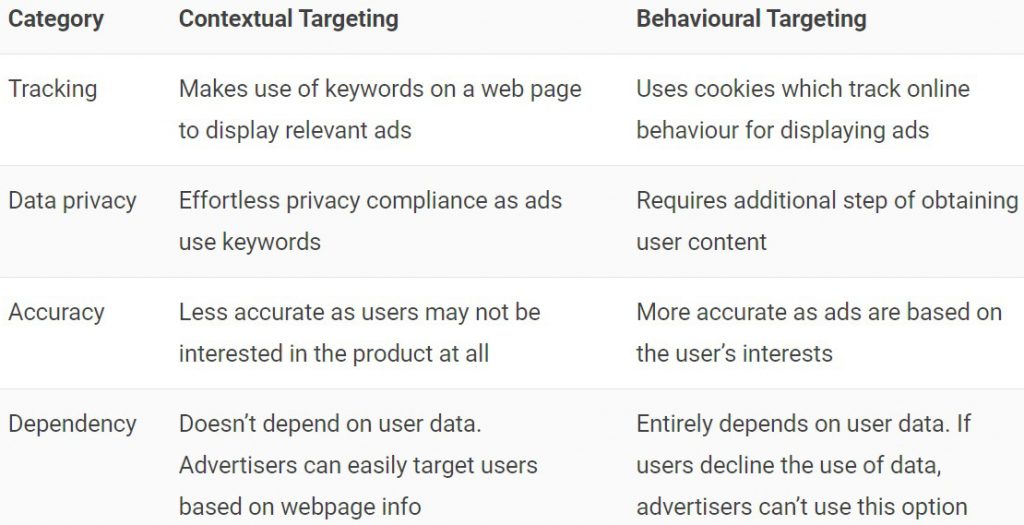
source: adpushup.com
The IAB Australia Data Council will be publishing a Contextual Targeting Handbook in H1 2021 as a comprehensive introduction for our members but we we’ll also be casting our eyes over how these types of solutions are evolving beyond brand safety and simple editorial relevancy.
An increasing expansion of the capabilities of the format to move beyond written content into analysing additional contextual content such as audio, video, and imagery is exciting. Additionally, as machine learning and AI capabilities continue to improve we should see contextual providing opportunities for unearthing some interesting targeting attributes for testing, as well as privacy-safe anonymised audience solution options.
Facebook & Instagram Products – an update
Facebook have recently provided the ability to create Instagram ads with product tags directly linked to paid promotions of products within the post. The available formats for ads with product tags include photos, videos and carousels.
As more brands start including product tags to their posts, one can assume that regular Instagram users will come to expect their presence, and should perform well. With the platform also making a very strong push on eCommerce right now, it looks as if Facebook are banking on product tags attracting and converting retail intent – with users looking for more, immediate info and the ability to increasingly quickly purchase products from posts whenever they come across something of interest to them.
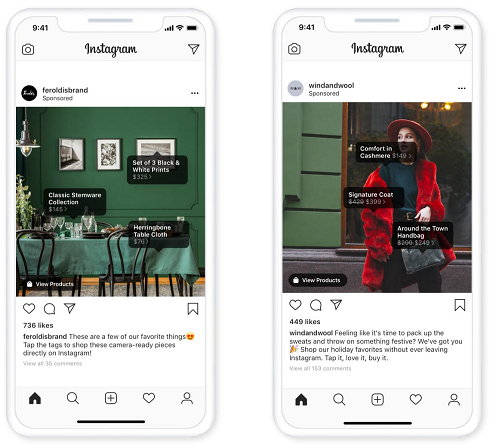 It’s a powerful product push and one can fully expect it to have a significant uptake moving forwards – particularly with the timing of an aggressive pre-Xmas run-up for retailers and consumers now fully embracing online shopping due to the COVID-19 global lockdowns.
This is additionally powerful when combined with the recently launched Discount Feature for Facebook Shops and also the tailoring of their custom audiences capabilities towards any prospective product conversions. Two product updates are interesting here and fairly self-explanatory from their names – Shopping Engagement Custom Audiences and Shopping Lookalike Audiences.
I’m surprised this hasn’t generated more noise in-market and it’ll be interesting to see its impact on both online retailers in terms of performance but also how consumers consume this type of content with an intention to purchase products as a primary driver rather than an ancillary benefit.