

Every fortnight or so we’ll bring you some technical updates that we hope you’ll find useful.
Today’s topics are a look at better understanding bias in artificial intelligence for marketing, how the capabilities of the PPID are being expanded in GAM & we review some tools for marketers under pressure to measure more effectively with the ongoing limitations within iOS.
PPIDs
Traditionally within GAM (Google Ad Manager) PPIDs have been identifiers tied to individual user logins, enabling publishers and advertisers to use PPIDs in place of a cookie, device ID, or IP address – for various core ad-serving features such as frequency capping across devices and audience targeting.
Google have now announced that publishers will be able to share PPIDs via GAM with advertisers on DV360 to enable certain features that require a user identifier. DV360 will also aggregate the PPIDs across all publishers to scale first-party data activation, enabling them to pool together their first-party data based on PPIDs with other publishers on GAM to eliminate scaling issues.
Google will never pass the actual PPID value and will instead turn them into “per-publisher partitioned IDs, so users cannot be identified across other publishers’ sites and apps“. Partitioning the data also ensures no data leakage occurs, which would devalue publisher first-party data. The formal update from the relevant blog is below:
“…we are launching new functionality that enables publishers to share Publisher Provided Identifiers (PPIDs) — pseudonymized first-party identifiers that are created and controlled by publishers — with Google’s programmatic demand. By helping publishers expand the use of their first-party identifiers to more transaction types, like the Open Auction, our partners will be able to show ads that are more relevant to their audiences, which will increase the value of their programmatic inventory.”
As PPIDs do not rely on cookies or device IDs, they are future-proofed from cookie deprecation or device ID restrictions. Additionally, as the PPID values are never directly shared, user privacy is preserved.
In terms of results from internal testing – it was also mentioned was that beta partners saw an increase of 15% or more in programmatic auction revenues when passing PPIDs in inventory without other identifiers.
Look out for our forthcoming ID Explainer handbook from the Data Council and to read the related Google blog post simply click here
Tools to help tackle ATT
As the repercussions of ATT continues to negatively limit measurement effectiveness within the iOS mobile advertising ecosystem, we continue to keep an eye on the impacts to our members. We will cover this issue in more detail before Xmas.
In the meantime there are a couple of recent updates on tools from Apple and Meta (aka. Facebook) that marketers should be aware of when looking to roll up their sleeves and try to measure more meaningfully within iOS.
Firstly, from Apple we’ve seen that within iOS 15.2 beta – Private Click Measurement (PCM) can now be used for in-app direct response advertising, as well as in Safari. PCM allows publishers and developers to attribute campaigns based on clicks from ad impressions on a site or app being deterministically linked to conversions from another site, without exposing user-level information.
This is achieved through using SFSafariViewController, which effectively embeds all of Safari inside your app using an opaque view controller – and is currently only available to iOS beta developers
To review the announcement about PCM simply click here
Secondly, from Meta we’ve seen the release of a marketing mix modeling tool called Robyn by the Facebook Marketing Science team, as Facebook is seeing conversions measured via SKAdNetwork being lower than previously recorded.
Robyn uses various machine learning techniques to define media channel efficiency and effectiveness, explore adstock rates and saturation curves. It is built for granular datasets with many independent variables and therefore especially suitable for digital and direct response advertisers with rich data sources.
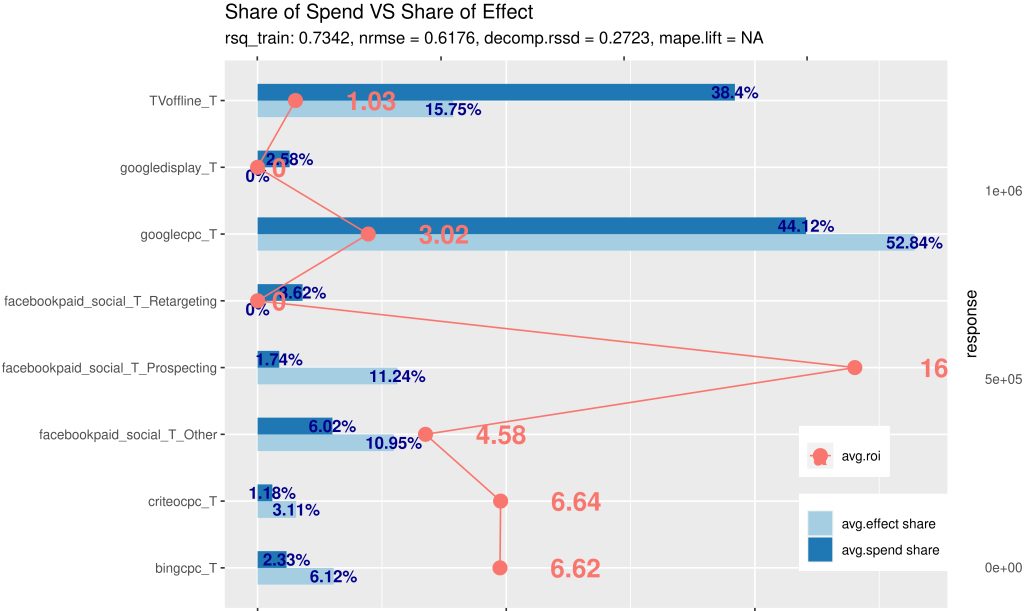
There has been some constructive criticisms of the results of this approach from some experts, and it’s worth reviewing these if you are looking to experiment – just to ensure a balanced view. An example of this is here
To learn more about Robyn simply visit the related GitHub here
Understanding Bias in AI for Marketing
In the US, the IAB’s AI Standards Working Group has recently published a very comprehensive guidebook titled Understanding Bias in AI for Marketing and has positioned the document as a ‘must-read’ for companies working to develop frameworks for better AI solutions in marketing.
Bias is generally introduced into AI systems unintentionally by humans, but the duality of humans and machines makes bias detectable and the risk mitigated helps companies do the right thing for their businesses and society.
Intended for consumption by the entire value chain, not just the solution developers – the guide uses examples from real-world experiences from AI professionals. Key terminologies are defined in detail and the document explores the roles and responsibilities of the full suite of stakeholders – categorising them as requestors, builders, end-users, compliance & legal teams, and consumers. We are taken through four distinct phases – labelled as awareness, exploration, development, and activation. In each of these the roles of the key stakeholders are examined along with their associated responsibilities as AI champions and arbiters of bias.
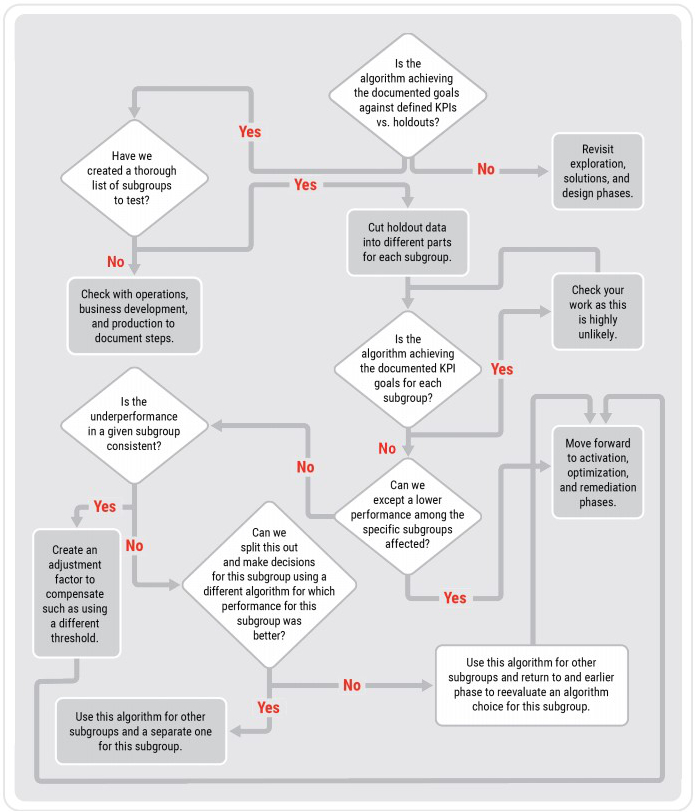
Various frameworks, modelling and checklists are incorporated, including a decision tree for assessing bias – shown below.
For the full report simply click here